For the organization

PadaMaster — the memory,
read for the organization.

Built on corporate data your company already owns. Nothing is asked of an employee before anything is offered.

Book a callCorporate data first · no survey, no timesheet.
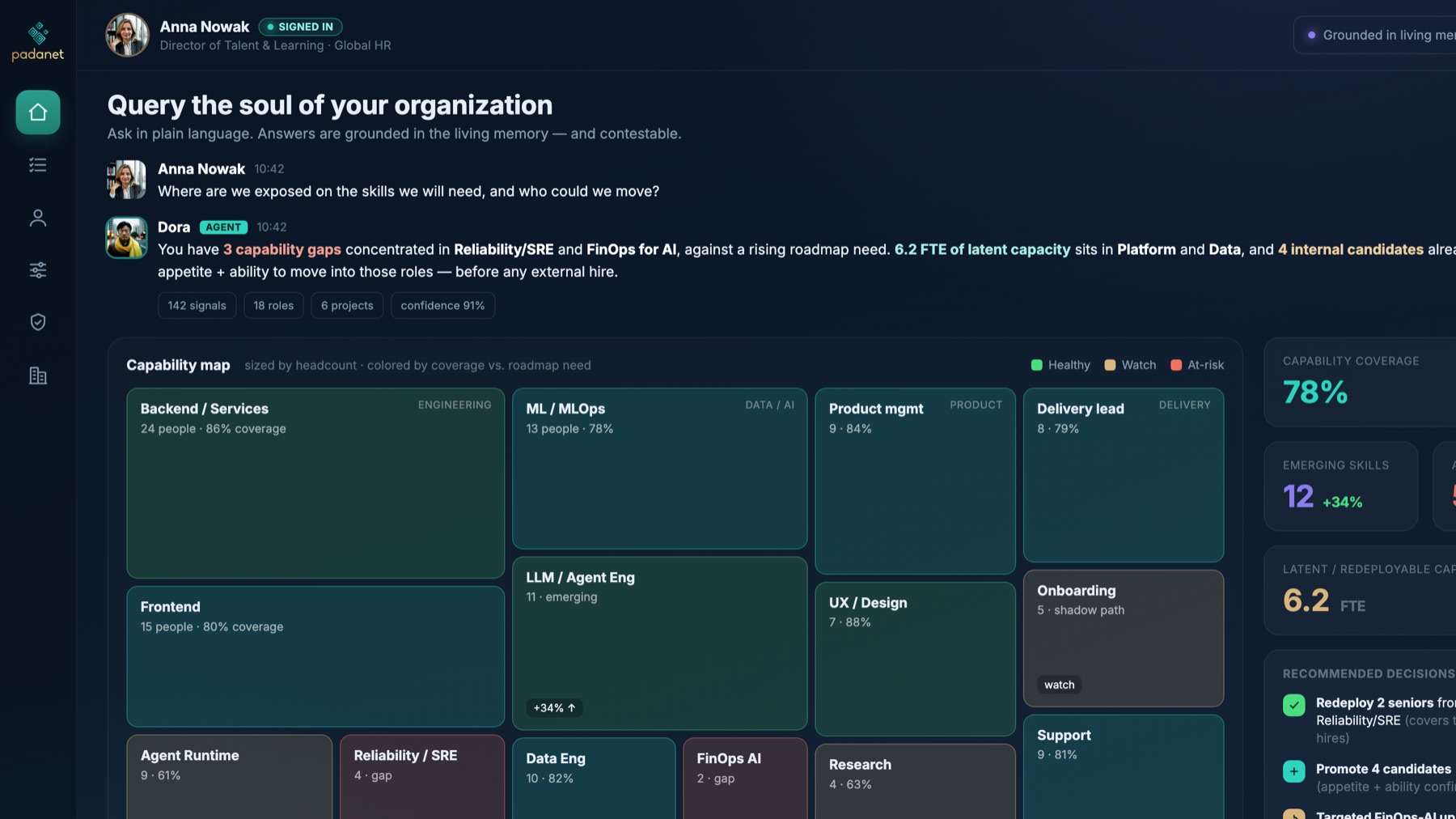
A leader asks where the organization is exposed on skills; the answer names three capability gaps and 6.2 FTE of latent capacity, with the signals, roles and projects it rests on, beside a capability map at 78% coverage.
A leader's question, answered with the evidence path attached.Illustrative — sample data

CORPORATE DATA ONLY

Read from systems the organization
already owns.

Find where your AI transformation is actually working — with evidence you can inspect.

Corporate data only

Read-only connectors

The systems the company already runs — work tracking, source control, documents, calendars — read where the work already happens, with scope agreed in the scoping phase.

  • No survey, no timesheet, no new tool to adopt
  • Metadata first: no keystroke or screen capture
  • Purpose-bound: each access names what it is for
  • Scope widened only by agreement, never silently
No adoption gate

Nothing asked before anything is offered

The organization starts seeing itself with what it already has. No employee has to install, declare or opt in before a leader gets a first answer.

  • Value on corporate data alone
  • Employees may opt in, for sharper resolution
  • The individual layer is never the price of entry
  • Trust earned before anything is asked
Aggregated by design

Answers about work, not readouts about people

Leader views are aggregated, with a floor below which nothing is shown. Where a claim would concern a person, it is consented or it is not shown.

  • No individual-level readouts
  • Evidence attached to every answer
  • Confidence and freshness on every claim
  • A correction path for each

THE QUESTIONS LEADERS ASK

Three questions the memory answers
with the evidence attached.

Each answer arrives with the evidence it rests on, its confidence, and how fresh it is.

Where is the delivery chain loaded?

Where work queues, which handoff is costing the most, which team sits on the critical path of work it is not resourced for — read continuously, not reconstructed by hand once a quarter.

Where did the constraint move?

After a step was accelerated, which next step now receives more than it can absorb, and what the intervention actually did — the baseline and the after, side by side.

Is capability where the business is heading?

What the organization can demonstrably do, where it is concentrated, what is emerging — and what a program would truly cost in time and capability.

HOW IT WORKS

Collect. Distil. Reveal.

Signals are collected where work already happens, distilled into a structured memory, and revealed as answers that open onto their evidence.

01

Step 01

Collect

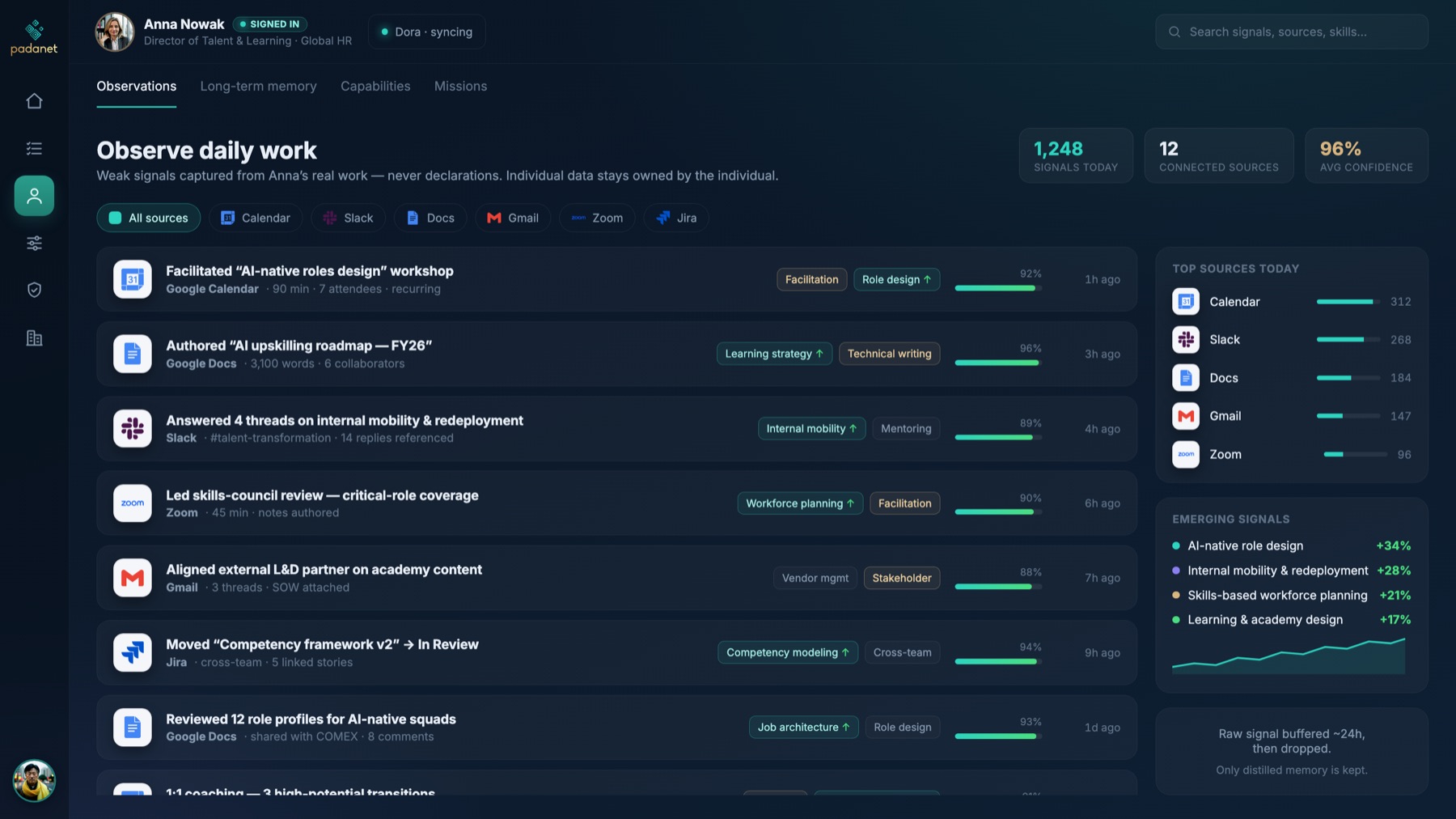
Signals are read from where work already happens — no survey, no timesheet, no new tool to adopt. Work on a team or the organization goes to the organizational agent; a person's own work goes to theirs.

A signals view: work observed across Calendar, Slack, Docs, Gmail, Zoom and Jira, each entry tagged with what it demonstrates and a confidence.
Signals as observations, with their source and confidence.Illustrative — sample data

02

Step 02

Distil

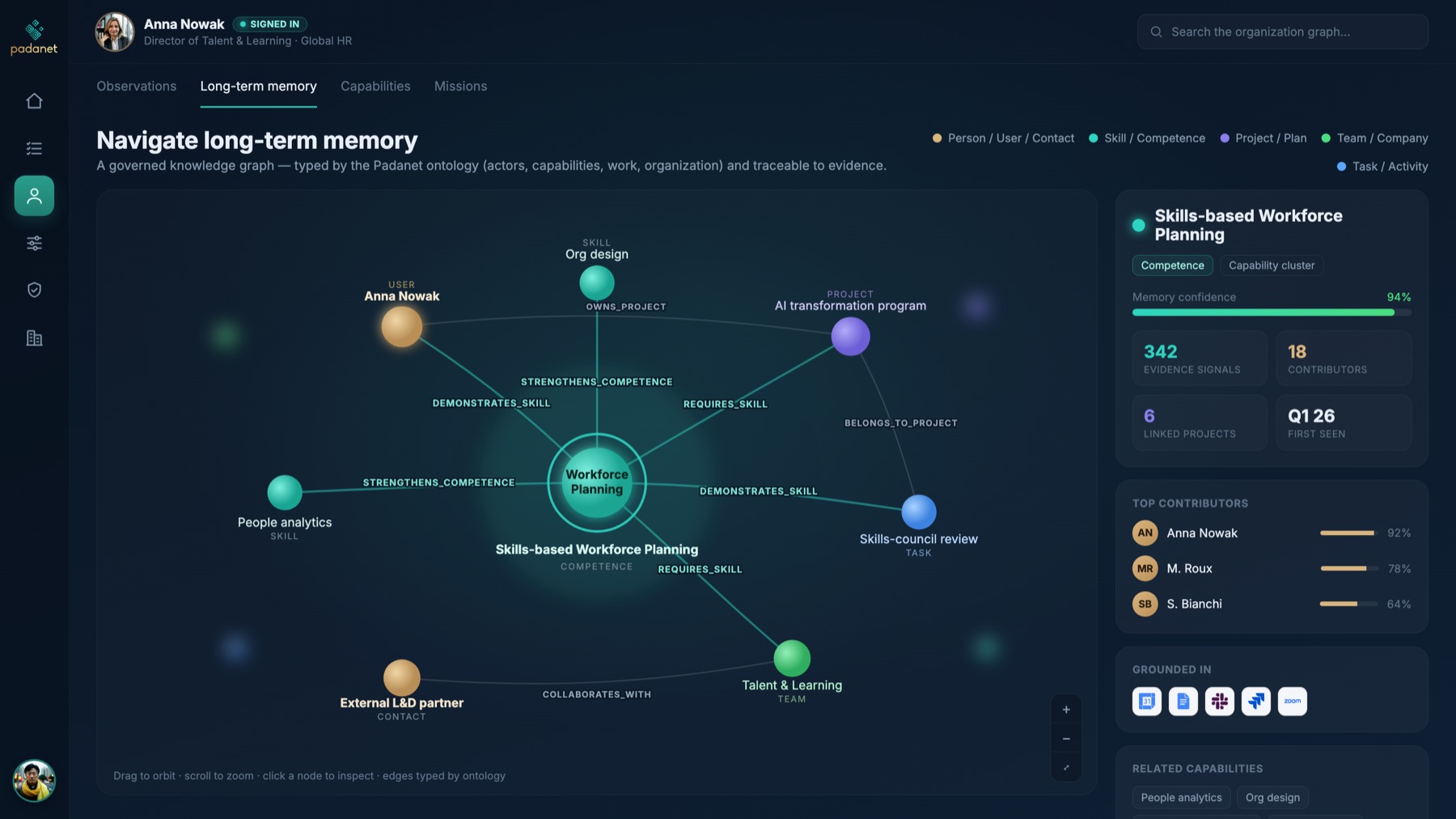
Signals become a structured, long-term memory: claims about process, collaboration, capability, cost and access, each linked to the evidence behind it, indexed by confidence, recency and who may see it.

The long-term memory as a governed graph: people, skills, projects, teams and tasks joined by typed relations, a selected capability showing its confidence and evidence count.
The memory as a governed graph, traceable to the evidence behind every claim.Illustrative — sample data

03

Step 03

Reveal

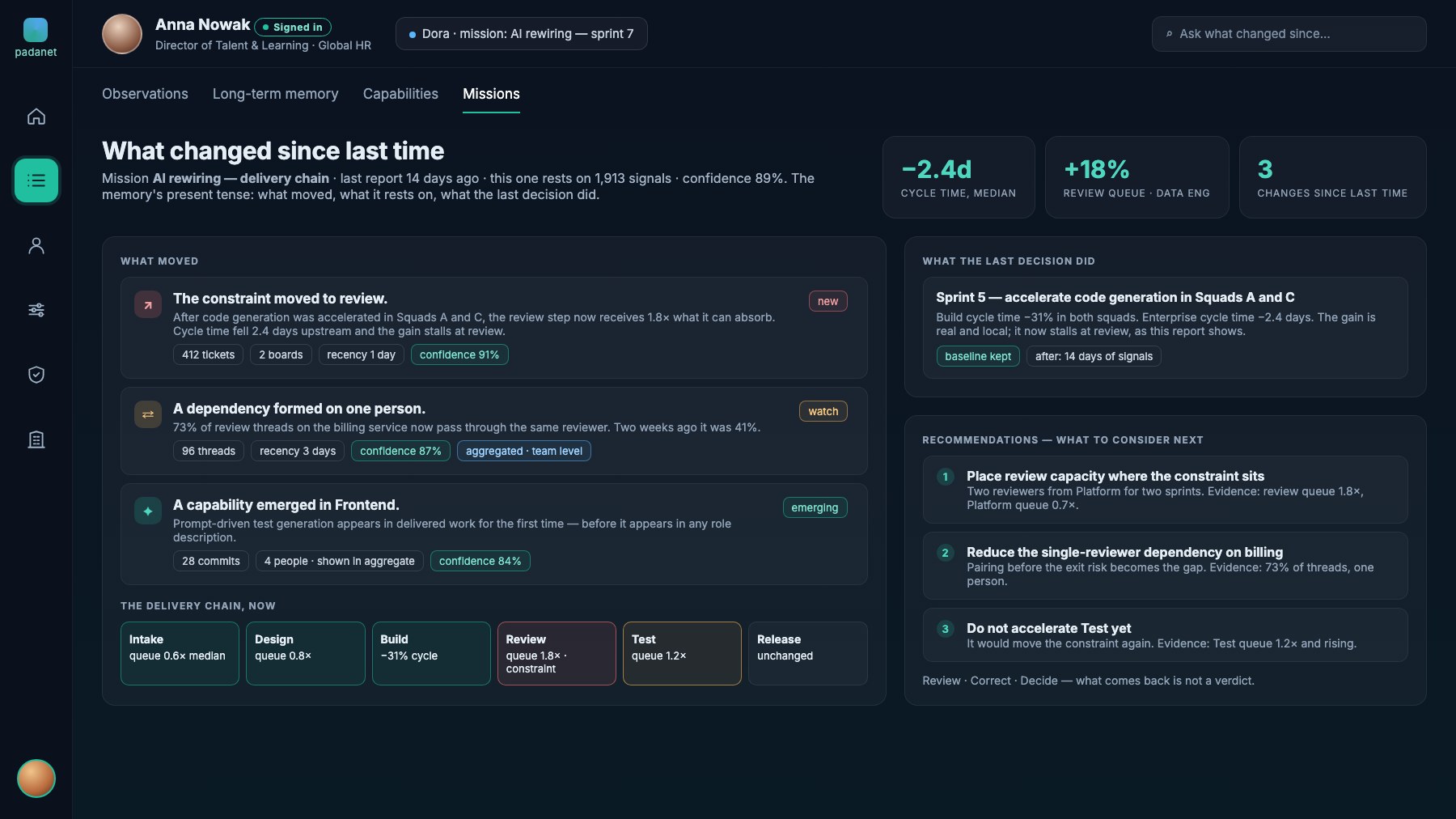
Ask in plain language. Every answer opens onto its evidence, carries its confidence, and says what changed since last time. People decide.

A mission's what-changed report: the constraint moved to review, a dependency formed on one reviewer, a capability emerged — each with its signals and confidence — beside what the last decision did and three recommendations.
What changed since last time, with what it rests on.Illustrative — sample data

WHAT COMES BACK

A diagnosis and recommendations you can open — and the improvement you can observe afterwards.

1

Capacity moved to where the chain is loaded

Load versus staffing, read from the work — so a reallocation rests on where work actually queues rather than on who argued loudest.

2

A step resequenced before the queue formed

Where the constraint moved after the last acceleration, and which handoff kept its old cadence — visible before delivery pays for it.

3

A program rescoped before it was committed

What the plan presumes, whether the organization has demonstrated it, and how concentrated it is — every assumption traceable to evidence.

4

A dependency named while the person is still there

Where know-how and de facto ownership sit with one person, and what depends on them — so succession is planned before the exit, not after.

Start with one decision. Start on evidence.

Every engagement opens with a fixed-fee scoping phase, credited in full if we continue together. Forty-five minutes with a founder is how it starts.

Book a call

There is something to see. Ask for a demo.