
PRODUCT · MEMORY

Signals become memory. Memory becomes recommendations you can act on.

Padanet is the memory. It distills the weak signals of real work into evidence-backed claims, keeps them current, and shows you what is changing.

Begin the conversation
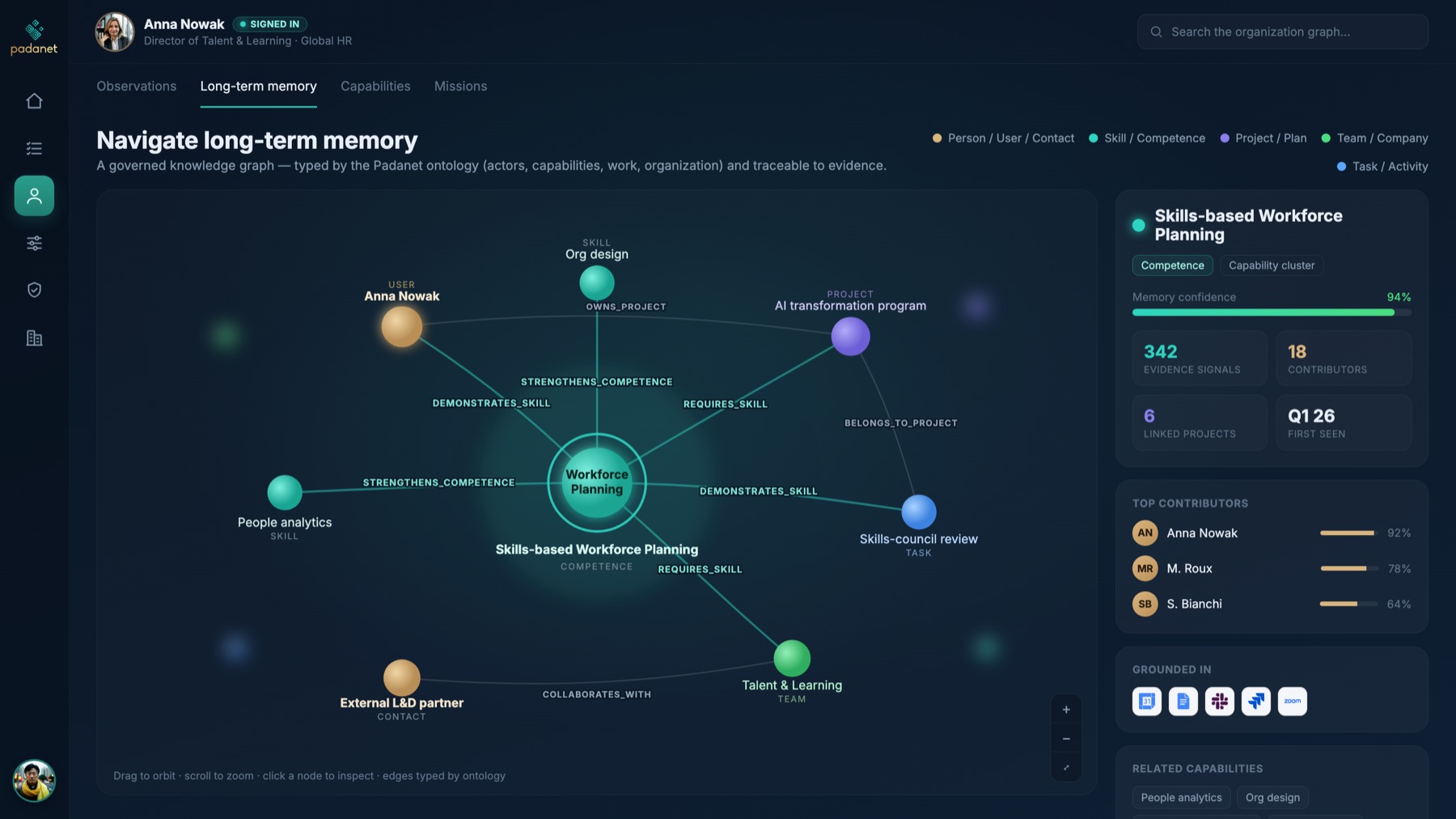
Every claim in the memory carries three things: the evidence behind it, the confidence the memory has in it, and how fresh it is. A correction path exists for each. Padanet does not ingest all company knowledge; it reads the signals of work, purpose-bound. A claim and the evidence path behind it are what an analyst means by a decision trace: not a record of a decision Padanet made, but the trail a person can follow to see what the memory saw and when. In the analyst’s vocabulary: an AI context platform at the organizational layer — a context graph of how this company actually works, plus the evidence behind each claim and the purpose each read declares.
The long-term memory as a governed knowledge graph: people, skills, projects, teams and tasks joined by typed relations, with a selected capability showing 94% memory confidence, 342 evidence signals and the systems it is grounded in.
The memory itself — a governed graph, typed by the Padanet ontology and traceable to the evidence behind every claim.Illustrative — sample data

Signals: what the memory is built from

Weak signals are the digital exhaust of work: a ticket moved, a merge reviewed, a document edited, a meeting held. They are read from corporate systems the company already owns, read-only and purpose-bound; the same piece of work seen across repository, tracker, documents and calendar becomes one signal.

Metadata first: no keystroke capture, no screen capture, no message content. A signal is an observation, never a conclusion. What the memory concludes from it is separate, traceable to it, and correctable — and a single signal is never enough to conclude anything about a person.
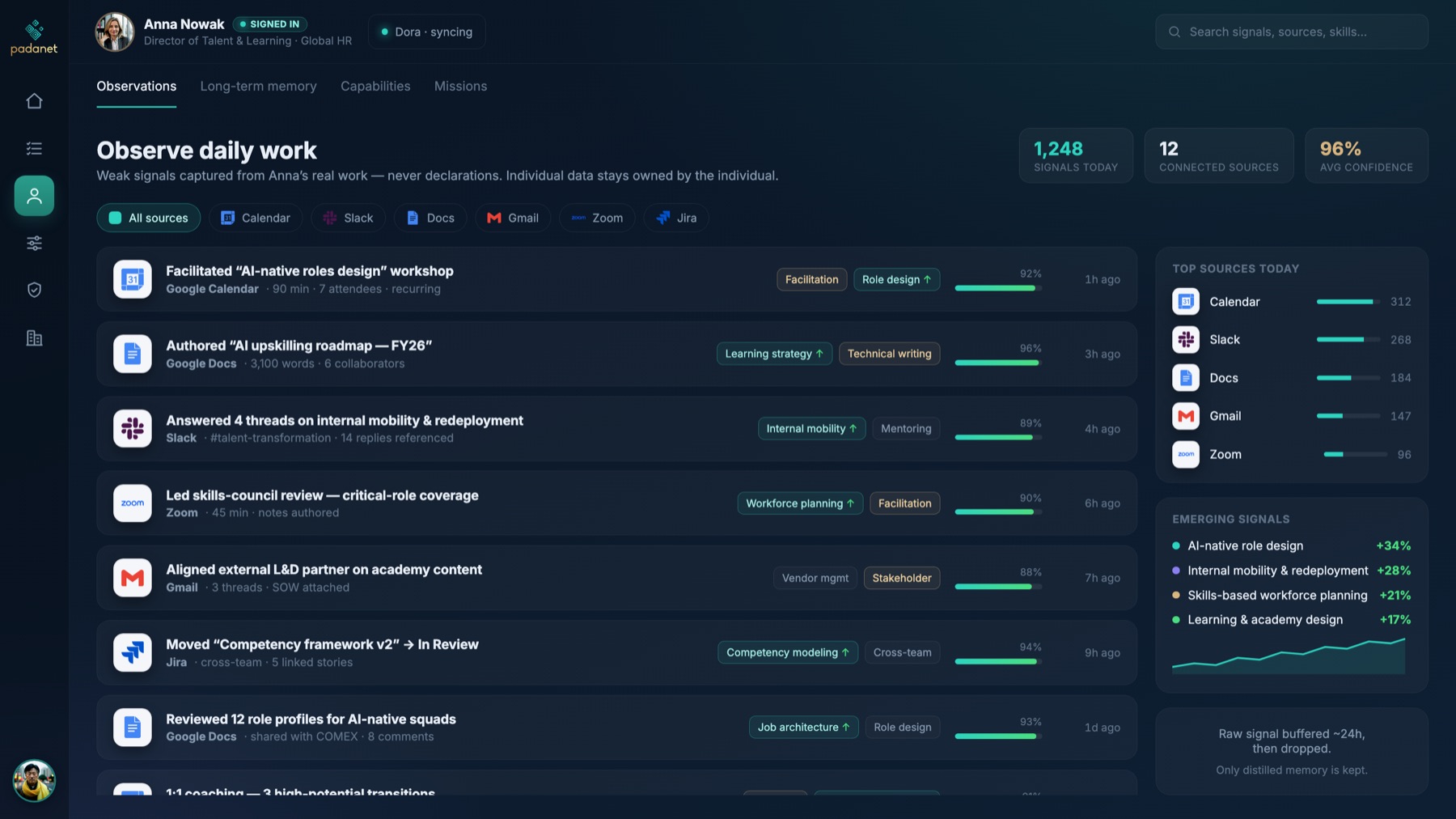
A signals view: work observed across Calendar, Slack, Docs, Gmail, Zoom and Jira, each entry tagged with what it demonstrates and a confidence, beside today's counts and the signals that are emerging.
Signals as observations, with their source and confidence — never message content.Illustrative — sample data

Missions: how the memory is asked questions

A mission is a bounded analysis that acts on the memory for one decision. It is a standing assignment rather than a one-off report: the question stays open, and the answer stays current, until the decision no longer needs it.
Goal
The decision the mission serves: where is the chain loaded, what does this program presume, what leaves with this person.
Scope
The teams, workflows and sources it may read — agreed in the scoping phase, never widened silently.
Tools and rules
What it may use and the constraints it runs under, including the purposes a claim may and may not serve.
Output
An insight with its evidence, a recommendation with its confidence — and, where you have agreed it, a proposal back into a system you own. Never a silent write.
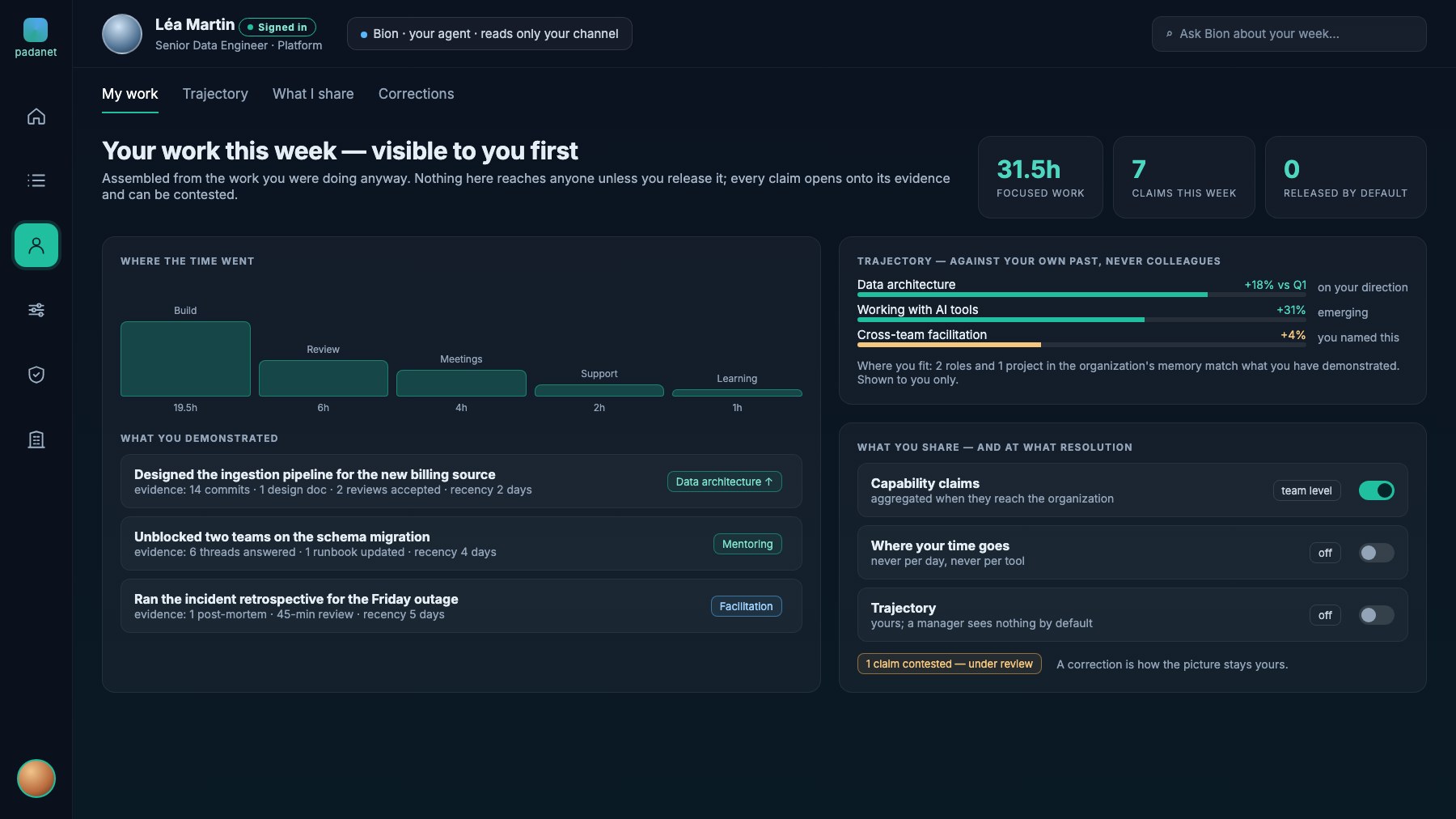
A person's own view in PadaOne: where the week's time went, three claims about what they demonstrated with their evidence, a trajectory measured against their own past, and the switches that decide what reaches the organization — nothing released by default.
The individual door: a person's own work, visible to them first, released only by their choice.Illustrative — sample data

What changed since last time

The memory is not a snapshot; it has a present tense. This is how a leader reads the memory without a data team, and how the memory shows what the last decision did.
What changed
The constraint that moved, the dependency that formed, the capability that emerged — since the last time you looked.
What it rests on
The signals behind each change, with the confidence the memory has in the reading and how fresh the evidence is.
What the last decision did
The baseline before an intervention and the same picture after it, so a decision can be judged by what it changed.
What to consider next
The move the evidence supports, stated as a recommendation with its reasoning — yours to take, defer or contest.
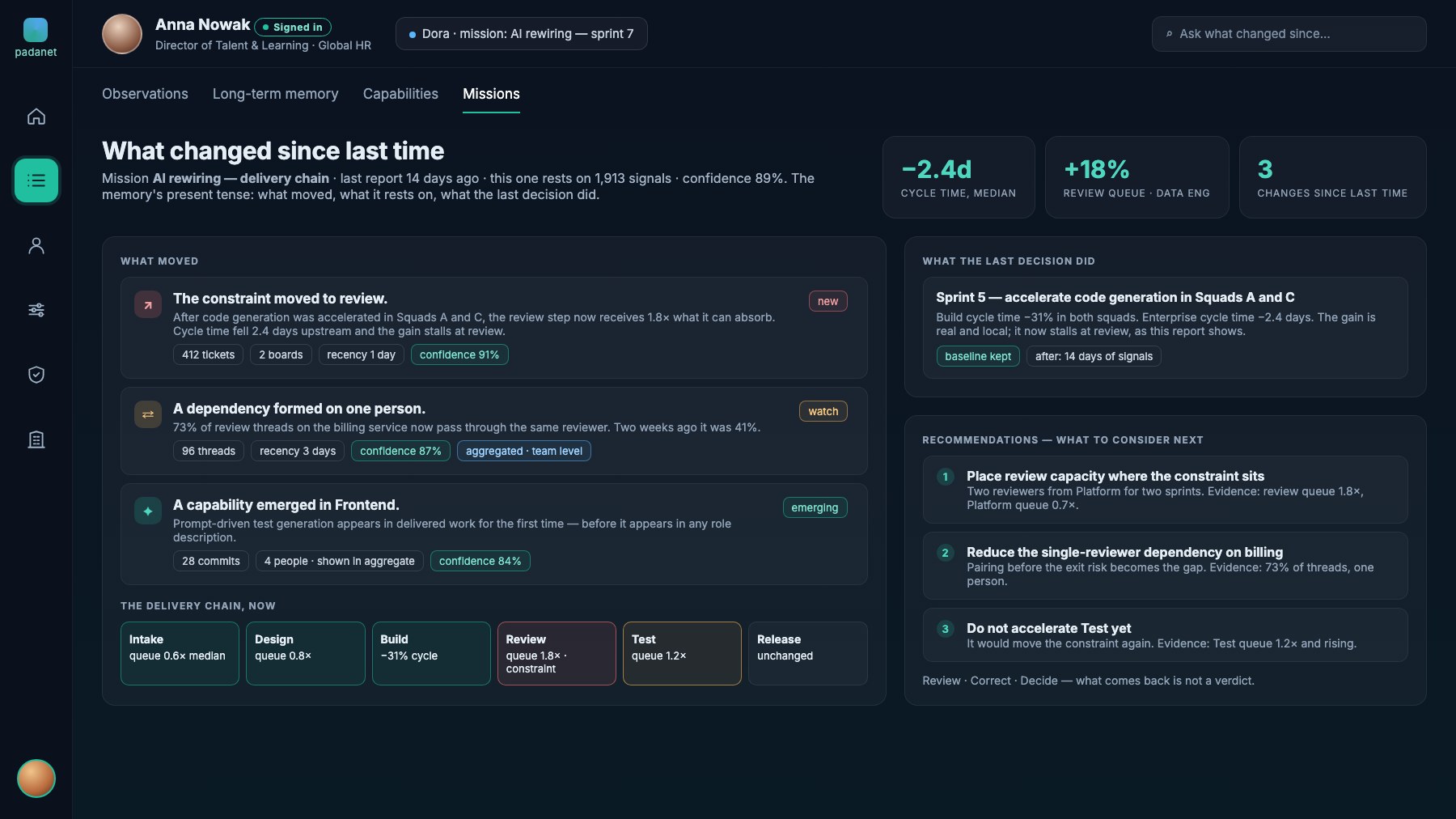
A mission's what-changed report: the constraint moved to review after code generation was accelerated, a dependency formed on one reviewer, a capability emerged in Frontend — each with its signals, recency and confidence — beside what the last decision did and three recommendations to consider next.
What changed since last time — what moved, what it rests on, what the last decision did.Illustrative — sample data

How to read what comes back

What comes back is not a verdict. It is a structured starting point grounded in evidence from real work.

01

REVIEW

Read what the mission produced and open the evidence behind any claim. The memory explains its reasoning; it does not ask to be believed.

02

CORRECT

Where a claim does not reflect the work, say so. Corrections are how the memory stays honest, and a correction path exists for every claim.

03

DECIDE

Take the move, defer it, or contest it. What comes back informs the decision; the decision is yours.

The doors onto it