Why Padanet exists
We are entering a new industrial revolution—one driven by cognition. Beyond automation: enabling human–AI partnerships that elevate people and allow organizations to continuously adapt.
The AI productivity paradox
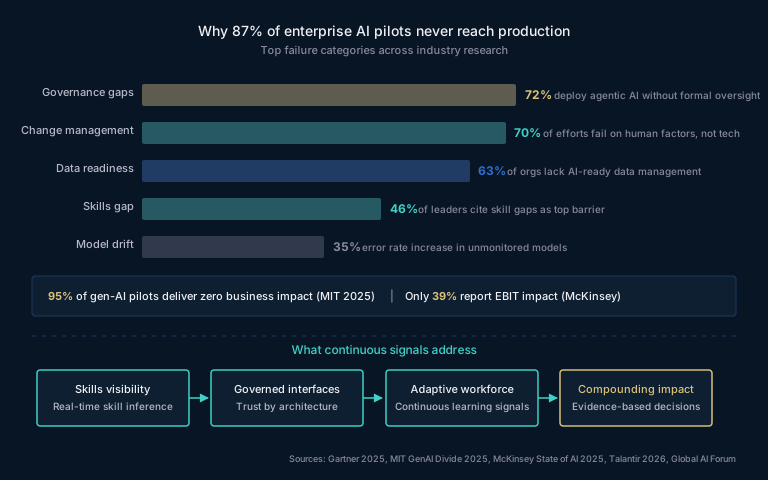
Despite massive investment, most AI initiatives fail to deliver meaningful, sustained impact.
The pattern is now clear:
- Pilots succeed, production fails
- Adoption is broad, impact is shallow
- Tools improve, outcomes stagnate
This is not a technology problem. It is an organizational and architectural failure.
The core fracture
Work now evolves daily:
- Tasks shift continuously
- Skills emerge and decay rapidly
- Human–AI collaboration becomes routine
Yet most organizations still rely on:
- Annual reviews
- Static job descriptions
- Declarative skill inventories
- Episodic workforce planning
This creates a structural blind spot:
You cannot steer what you cannot see.
The transformation challenge
For organizations
Organizations cannot survive the AI era as rigid hierarchies built around fixed positions and slow cycles.
They are evolving toward fluid, hybrid organizations: organized around missions and projects, dynamically recomposed around expertise, continuously sensing, learning, and adapting.
For individuals
For individuals, the AI revolution manifests as:
- Constant upskilling pressure
- Fear of skill obsolescence
- Fragmentation across dozens of tools
- Loss of visibility into one's own trajectory
Traditional markers of employability—titles, degrees, CVs—no longer reflect reality.
The solution
The future of work is not human versus AI. It is human with AI.
Lasting value emerges from skill partnerships where human judgment, context, and ethics combine with AI's scale, pattern detection, and speed.
The first wave of AI focused on automation. The next wave will determine whether AI diminishes human agency—or elevates human potential.
The decisive factor is visibility.
Our stance
Padanet stands for:
- Clarity over hype
- Trust over extraction
- Evidence over assertion
- Human agency over blind automation
We are not trying to predict the future. We are building the foundations to navigate it.