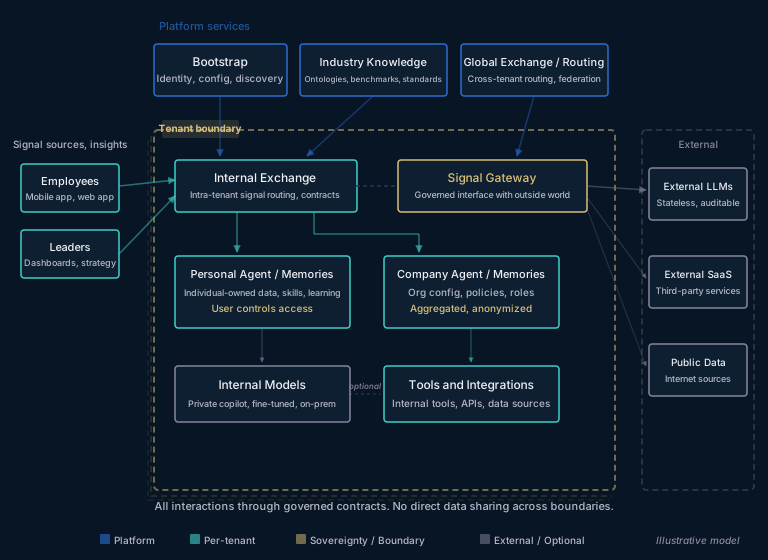
How Padanet works
Padanet is built on four foundational concepts: continuous signals, distributed agents, layered memory, and trust by design.
Continuous signals
Padanet uses continuous signals—real-time observations of work—rather than snapshots. Instead of waiting for annual reviews or periodic assessments, the system observes work as it happens.
Signals carry context: role, project, timeframe, intent. This ensures that meaning isn't lost when information moves through the system.
The approach is event- and signal-driven, enabling ongoing understanding without surveillance. Signals are contextualized, traceable, and respect boundaries—they inform intelligence without compromising privacy or agency.
Agents
Intelligence is distributed across specialized agents, each with clear roles and boundaries:
Observe individual work, infer skills and learning, provide guidance, and enforce personal data boundaries. They act in the individual's interest first and never default to sharing.
Detect patterns and trends at team or company levels, supporting organizational reasoning. They reason on patterns, not people, and cannot bypass individual consent.
Monitor platform health and enforce policies while remaining auditable.
Agents communicate through explicit contracts and governed interfaces, preserving context and enabling coordination without centralizing power or leaking private information.
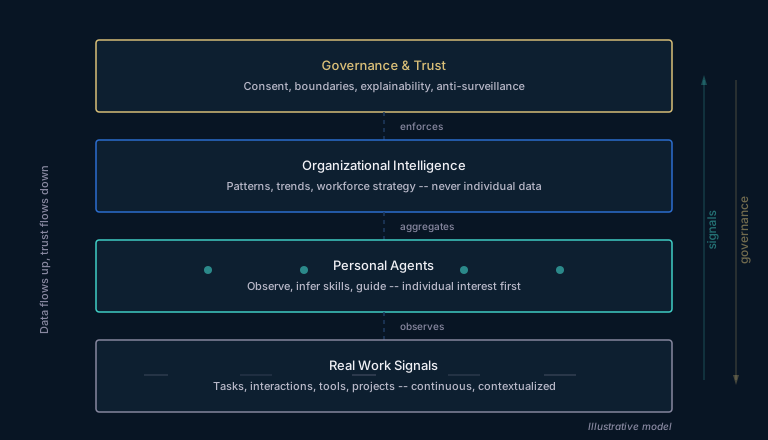
Memory
Memory enables continuity and learning. It's layered and selective:
- Short-term memory — supports immediate reasoning within a session
- Personal memory — owned by the individual, preserves skills and learning patterns over time
- Organizational memory — governed, aggregated, and anonymized, focused on patterns rather than individuals
- System memory — enables the system to learn how it learns, without personal data
Memory preserves meaning and context, not just data. Knowledge is provisional and evolves over time. The system supports intentional forgetting to prevent outdated information from creating bias.
All memory access is explicit, logged, and reviewable.
Trust and governance
Trust is enforced by architecture, not just policy.
Data, agents, and memory are separated by design, preventing unauthorized access or inference.
Granular, informed, revocable consent with defaults favoring minimal sharing and individual control.
All inferences must be explainable, showing sources, confidence levels, and limitations.
The system rejects requests that enable monitoring, ranking, or disciplinary enforcement of individuals.
The system surfaces potential bias and avoids reinforcing inequities.
Humans remain responsible for decisions; AI actions are traceable.
Trust loss is treated as a system failure. The system is designed assuming misuse is possible, with safeguards that protect individuals and organizations while preserving human agency.
If the product delivers insight without trust, it fails. If it delivers trust without insight, it stalls.